
Hammam or sauna: which to choose as a couple, and in what order with the jacuzzi
Dry or humid heat, how long to stay in, the order with the jacuzzi, and champagne: what is established, what is only a convention, and a timed plan for a private spa evening for two.
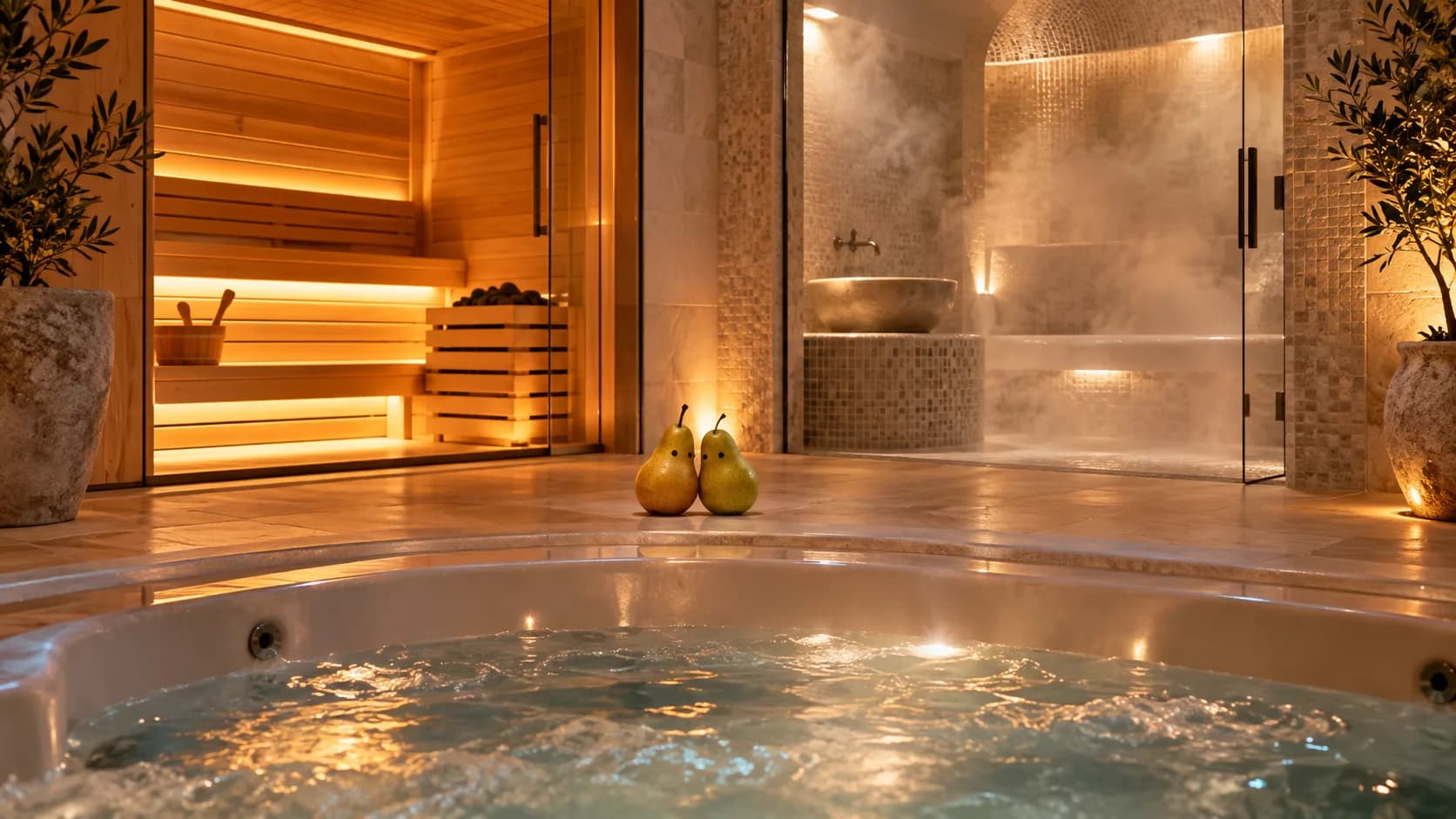
Hammam or sauna: the simplest difference is the air — much hotter and drier in a traditional sauna, lower in temperature but very humid in a hammam. For a couple, neither is inherently “better”: the useful question is which environment each of you tolerates and enjoys.
If your room has all three facilities, none of the health authorities we checked — Harvard Health, Cleveland Clinic or the CDC — prescribes an order between sauna, hammam and jacuzzi. What is much better established is the need to cool down, rest and rehydrate between heat exposures.
For a private spa evening, our practical convention is therefore: hammam → cool down and rest → sauna → cool down and rest → jacuzzi last, with no alcohol around the baths. The sequence itself is not a medical recommendation. The pauses are the important part.
Hammam or sauna: the answer in one table
The quickest distinction is simple: sauna means hotter, dry air; hammam means lower temperatures in very humid air.
The figures for sauna are relatively well documented. Hammam figures vary more from one study, operator and manufacturer to another.
Traditional sauna | Hammam | |
|---|---|---|
Type of heat | Dry | Humid, with steam |
Temperature | 80–100°C in the Finnish sauna reference; about 65–90°C according to Cleveland Clinic | Around 40–50°C depending on measurements and operators |
Humidity | 10–20% in the Finnish sauna reference | Very high: 84% measured in a Turkish study, up to 100% according to manufacturers |
Length of one session | Harvard Health: no more than 15–20 minutes; Cleveland Clinic: start with 5 minutes if you are new to sauna | No duration set by the health authorities consulted; around 10–15 minutes is common usage, not a medical recommendation |
Main experience | Strong, dry heat | Lower-temperature, steam-filled environment |
Worth considering if… | You prefer dry heat | You prefer humid heat |
Sources for the figures. Laukkanen et al., in JAMA Internal Medicine in 2015, describe a traditional Finnish sauna as having 10–20% humidity and cite 80–100°C at face level. The cohort consisted of Finnish men aged 42–60. Cleveland Clinic gives roughly 65–90°C and humidity below 20% for a traditional sauna.
For the hammam, a Turkish study involving 47 volunteers measured 39.7°C and 84% humidity. Munich municipal baths, SWM, give about 45°C for their steam bath, while manufacturers cite figures around 48°C and as much as 100% humidity. That is why a sensible summary is around 40 to 50°C depending on measurements and operators, in very humid air: 84% measured in a Turkish study, up to 100% according to manufacturers.
Dry heat, humid heat: what really separates them
The sauna: dry air, a wooden cabin and the infrared variant
A Finnish-style sauna combines relatively dry air with high temperature. The 2015 Finnish cohort paper describes 10–20% humidity and an 80–100°C recommended range at the bather’s face. Cleveland Clinic uses a somewhat broader real-world range of about 65–90°C with humidity below 20%.
An infrared sauna is a different piece of equipment. According to the Cleveland Clinic sauna guide, infrared saunas are typically around 43–57°C. The infrared energy heats the body rather than bringing the room air up to the temperatures used in a traditional sauna.
That difference matters when booking. “Private sauna” does not tell you whether you are getting a Finnish-style cabin or an infrared installation, and the temperature ranges are not interchangeable.
The hammam: steam, and less consistent figures
Hammam temperatures are harder to summarise because the available figures come from a mixture of measurements, operators and equipment manufacturers. One Turkish study measured 39.7°C and 84% humidity; SWM describes its steam bath at around 45°C.
You will also encounter much wider claims online — including temperatures as high as 70°C for hammams and sauna humidity figures ranging from 3% to 30%. That variation is one reason not to treat a single generic number as a specification for the room you are actually booking.
Which should you choose as a couple?
A hammam as a couple makes sense when both of you are comfortable in dense steam. A sauna for two in your own private room may suit you better if you both prefer dry heat.
The more important point is that you are two different bodies. One partner may want to leave well before the other. Neither of you needs to “complete” a session just because the other person is still comfortable.
The catalogue also changes the practical choice. As of 7 October 2026, across 1,168 listings published on Love in Room, 426 include a sauna, or 36.5%, while 103 include a hammam, or 8.8%. Hammams are therefore about four times rarer. Sixty-two listings include both, meaning roughly six out of ten listings with a hammam also have a sauna.
That makes an accommodation combining both particularly useful when your preferences differ. You can compare a room with a private hammam with a room with a private sauna without assuming that you both need to spend the same amount of time in the same heat.
How long to spend in the sauna, hammam and jacuzzi
For sauna, there are clear public-health-style precautions. Harvard Health says to stay in for no more than 15–20 minutes, then cool down gradually. Cleveland Clinic advises beginners to start with 5 minutes.
SWM uses a more structured operating rhythm: 8–12 minutes per sauna session, never more than 15, two to three sessions, with 20–30 minutes of rest between them. Those figures are an operator’s practice, not a medical prescription.
The 2015 Finnish cohort offers another useful reference point, but again not a rule: the average reported sauna session lasted 14.2 minutes.
For the hammam, none of the health authorities we consulted gives a recommended duration. The 10–15 minutes widely seen in consumer guidance should therefore be treated as customary practice, not as a medically established ideal.
For the jacuzzi, Cleveland Clinic advises keeping a soak to 15 minutes or less: beyond that, the heat can lower blood pressure and cause dizziness. Harvard’s 15–20 minute recommendation applies to sauna, not to the jacuzzi.
Temperature is much clearer. The CDC’s hot-tub guidance states that the water should never exceed 40°C. The older CPSC guidance considered 38°C safe for a healthy adult and warned that thermostats could be wrong by around 2°C, which is why checking with a thermometer can be useful. The age of the CPSC source is worth keeping in mind.
The CDC also advises showering before entering a hot tub and not swallowing the water.
Sauna, hammam, jacuzzi order: evidence versus convention
The most important distinction in this article is between the order itself and what happens between two heat exposures.
What is established: recovering between two heat exposures
What is better supported is cooling and recovery. Harvard Health tells sauna users to cool down gradually. SWM builds cooling and a 20–30 minute rest period into its practical sauna routine.
A small 2026 study in Experimental Physiology adds experimental evidence. Sixteen healthy adults completed two 15-minute sauna bouts at 85°C. When the cooling break included 90 seconds in water at about 20°C, core temperature and heart rate were lower at the end of the second sauna bout than when participants cooled in air alone. With only 16 participants, this should be read as a small physiological experiment, not as a reason everyone should take a cold plunge.
The order itself has not been demonstrated
No health authority we checked — Harvard Health, Cleveland Clinic or the CDC — prescribes an order between sauna, hammam and jacuzzi. Their relevant guidance addresses safe use, temperature, cooling, alcohol and individual health risks, not a mandatory three-step sequence.
So there is no medically established “correct” answer such as sauna first or hammam first.
Our order is therefore a practical convention: hammam → cool and rest → sauna → cool and rest → jacuzzi.
Sauna before or after the jacuzzi?
Starting with the hammam follows the intuitive “lower air temperature before higher air temperature” logic. Keeping the jacuzzi last follows a different practical logic: once you get into the final warm bath, you do not need to get out and head straight back into another heat source.
For a stay built around a room with a private jacuzzi, that also makes the evening easier to organise. You move through the hotter cabins first, recover, then finish the bathing part of the evening in the water.
Cold, but progressively
The cold part should be progressive. A cool shower is an option, not an obligation and not a test of endurance.
A Swiss study published in 2016 in the European Journal of Preventive Cardiology followed 37 men around 60 years old, including men with heart failure or coronary artery disease. After two 80°C sauna exposures, head-out immersion in 12°C water increased systolic blood pressure in all groups.
A case of heart attack after alternating sauna heat and cold water has also been reported in the medical literature. That is a single case, not evidence that ordinary cool showers are dangerous, but it is another reason not to treat an abrupt “thermal shock” as something you need to achieve.
The evening, timed
0:00–0:15 — Settle in. Have a large glass of water and take a lukewarm shower. The CDC recommends showering before using a hot tub.
0:15–0:25 — Hammam. Around ten minutes is a usage-based starting point, not a medically prescribed duration. Leave sooner at the first sign of discomfort.
0:25–0:50 — Cool down, lie down and drink water. A 20–30 minute break matches SWM’s practical rhythm between heat sessions.
0:50–1:00 — First sauna session. Use roughly 8–12 minutes as the SWM operating reference. If you are new to sauna, Cleveland Clinic suggests beginning with about 5 minutes.
1:00–1:25 — Cool down and rest. Harvard Health recommends 2–4 glasses of cool water after each sauna.
1:25–1:37 — Optional second sauna session. SWM uses two to three sessions as a practical rhythm. There is no reason to add another round if either of you has had enough.
1:37–2:00 — Cool down and rest again.
2:00–2:15 — Jacuzzi at around 38°C, never above 40°C, with no alcohol. Cleveland Clinic advises no more than 15 minutes; the CDC sets 40°C as the maximum water temperature. Leave at the first sign of unusual sleepiness or feeling unwell.
2:15–3:00 — Robe, water and a light meal.
Later in the evening — Champagne, if you want it. Only once the bathing part of the evening is finished and you have rehydrated. Do not return to the jacuzzi afterwards.
Hammam then sauna is a convention. What matters is the cool recovery period between heat exposures and keeping alcohol away from the baths.
Champagne, water, meals: the point that matters most
Alcohol is probably the most practically important safety point for a romantic spa stay.
Harvard Health recommends avoiding alcohol before and after sauna use. Cleveland Clinic says not to use a sauna after drinking. The CDC says not to drink alcohol before or during hot-tub use.
Hannuksela and Ellahham’s 2001 review in The American Journal of Medicine states that alcohol during sauna use increases the risk of hypotension, arrhythmia and sudden death and should be avoided.
The Finnish forensic data are particularly useful in this context. In Kenttämies and Karkola’s 2008 study of sauna deaths in Finland from 1990 to 2002, 50% of all cases were under the influence of alcohol. The authors specifically advised against leaving an intoxicated person alone in a sauna.
For a Love in Room evening, the practical consequence is straightforward: no champagne before or during the sauna, hammam or jacuzzi. If you want to open the bottle, wait until you are finished with the baths for the evening, rehydrate first, and do not go back into the jacuzzi afterwards.
Hydration matters because sauna sweating is substantial. The 2015 JAMA Internal Medicine paper reports an average total sweat loss of around 0.5 kg during a typical sauna session. Harvard Health recommends 2–4 glasses of cool water after each sauna.
For food, Finnish Sauna Society guidance advises avoiding a large meal before sauna use. We found no well-sourced universal waiting period, so there is no basis for telling you to wait “90 minutes” or any other precise interval.
Who should seek medical advice?
Avoid: Cleveland Clinic advises against sauna after a recent heart attack or stroke, and after drinking alcohol. Hannuksela and Ellahham list unstable angina and severe aortic stenosis among contraindications. Most people with stable coronary disease tolerate sauna, according to the same review. If you are ill, Harvard Health says not to use the sauna, and to leave if you feel unwell.
Medical advice: seek medical advice first if you are over 65, have heart disease or heart failure, abnormal blood pressure, epilepsy, or take medication, according to Cleveland Clinic; Harvard Health also advises medical guidance for uncontrolled hypertension. People with low blood pressure should keep sauna sessions shorter.
In case of pregnancy, ask your doctor or midwife; health authorities recommend the greatest caution, especially in the first trimester, and Cleveland Clinic discourages sauna, hammam and jacuzzi throughout pregnancy.
What heat does not do
“Eliminating toxins”: a physiological review by Baker in Temperature in 2019 says that sweat appears to play only a minor role in eliminating waste products and toxicants compared with excretion through the kidneys and gastrointestinal tract.
“Losing weight”: Cleveland Clinic explains that the immediate change on the scales is water lost through sweating and regained through rehydration. It is not fat loss.
“Protecting the heart”: the Finnish 2015 study found an association between more frequent sauna use and lower cardiovascular and all-cause mortality among Finnish men, but an observational association does not establish that sauna itself caused the difference.
As for claims that hammam steam “opens the pores” or “cleans the lungs”, we found nothing solid enough in the sources we consulted to present either as an established health benefit.
What to wear and what to bring
In a private spa, what you wear is primarily a matter of your own comfort and the accommodation’s rules. Sitting on a towel on the sauna bench is common practice; it is not being presented here as a medical rule.
Before travelling, check whether robes, towels and slippers are supplied.
Questions to ask the host before booking
Are the sauna and hammam inside your room or private area and reserved exclusively for you, or shared with other guests? “Private” can describe different arrangements from one property to another.
Is access available throughout the stay or restricted to a set time slot? A two-hour spa window and unrestricted evening access require very different planning.
Is the sauna traditional or infrared? Their operating temperatures differ significantly.
What temperature is the jacuzzi set to, can it be lowered and is there a thermometer? The CDC ceiling is 40°C.
How is the jacuzzi water maintained and renewed? The CDC recommends checking disinfectant and pH levels in hot tubs.
Is there a shower close to the heat facilities? It makes cooling down between sessions easier, and the CDC recommends showering before entering a hot tub.
Are robes and towels supplied, what time can you arrive, and is there a daytime option? For a daytime stay rather than an overnight booking, Love in Room also offers day-use love rooms.
Where to find a private sauna or hammam
As of 7 October 2026, across the 1,168 listings published on Love in Room, 467 have either a sauna or hammam — roughly four listings in ten. There are 245 listings combining sauna and private jacuzzi, 64 combining hammam and private jacuzzi, and 41 combining sauna, hammam and private jacuzzi.
Love in Room listings, 7 Oct 2026 | Count | Median starting price per night |
|---|---|---|
All listings | 1,168 | €190 |
With sauna | 426 | €199 |
With hammam | 103 | €220 |
With sauna and hammam | 62 | €220 |
With sauna, hammam and jacuzzi | 41 | €240 |
These are median minimum advertised prices, not rates for a specific night. In other words, half of hammam listings start at €220 or less and half at €220 or more.
You can browse a love room with a private spa, a room with a private hammam or a room with a private sauna.
For location-based searches, Love in Room also has a love room in Strasbourg, private hammams around Lyon, private hammams in Paris, rooms with a sauna around Lyon, rooms with a sauna around Paris and private hammams near Marseille.
Frequently asked questions
Which is better, a hammam or sauna?
Neither is universally better. A traditional sauna uses much hotter and drier air; a hammam uses lower temperatures with very high humidity. For a couple, the more useful criterion is which environment each of you actually enjoys.
Which is hotter, a sauna or hammam?
The air temperature is clearly higher in a traditional sauna. The Finnish reference is 80–100°C, while hammam measurements and operator figures are generally around 40–50°C. Those numbers alone do not tell you which one will feel hotter to you.
What order should sauna and hammam go in? Can you do both?
None of the health authorities consulted prescribes an order. Our practical sequence is hammam, cool and rest, then sauna. The important part is not moving directly from one heat exposure to another without recovery.
Should the jacuzzi come before or after the sauna?
There is no established medical order. For an evening for two, we put the jacuzzi last, after cooling and resting following the sauna, because it gives the bathing sequence a natural end. Keep the water below 40°C and, following Cleveland Clinic, the soak to 15 minutes or less.
What is the ideal hammam session length?
None of the health authorities we consulted specifies an ideal hammam duration. Around ten minutes is a practical usage-based reference, not a medical prescription.
What are the main sauna and hammam contraindications?
For sauna, avoid it after a recent heart attack or stroke, after alcohol, and in situations such as unstable angina or severe aortic stenosis. Seek medical advice with heart disease, heart failure, abnormal or uncontrolled blood pressure, epilepsy, relevant medication use or if you are over 65 and unsure whether heat exposure is suitable for you.
Does sauna make you lose weight? How many calories does 15 minutes in a hammam burn?
Cleveland Clinic says short-term weight loss after sauna is water loss and is reversed by rehydration. We did not find a sufficiently reliable figure for calories burned during 15 minutes in a hammam.
Why do people not wear a swimsuit in a sauna?
In a private sauna inside your room or reserved spa area, clothing is a matter of your comfort and the property’s rules. Neither nudity nor wearing a swimsuit is presented here as a medical requirement.
Hammam or sauna for someone with asthma?
Ask your doctor, especially if heat or steam usually affects your symptoms. A few older reviews based on small groups describe slight changes in breathing in the sauna, rather a temporary improvement in some people with asthma. That evidence remains limited.
Read also
Continue your editorial journey

Romantic Getaways: Why Unusual Stays Can Bring You Closer
Sleeping in a treehouse, under a transparent dome or on the water changes your habits, your pace and the attention you give each other. Here is why unusual places can create more room for connection — and how to choose the kind of stay that suits you both.

Wedding Anniversary: Gifts, Messages & Celebration Ideas
Find the right gift, write something personal and decide how to celebrate your wedding anniversary. Includes the French anniversary chart and real prices from 1,161 Love in Room stays.
Sleeping in a transparent bubble
Sleeping under a transparent wall means keeping the sky in view once you are in bed. Where to find one in France, what it costs, what a private hot tub adds, and how to tell an inflatable bubble from a geodesic dome: everything worth checking before you book.