

Sleeping in a transparent bubble
Sleeping under a transparent wall means keeping the sky in view once you are in bed. Where to find one in France, what it costs, what a private hot tub adds, and how to tell an inflatable bubble from a geodesic dome: everything worth checking before you book.
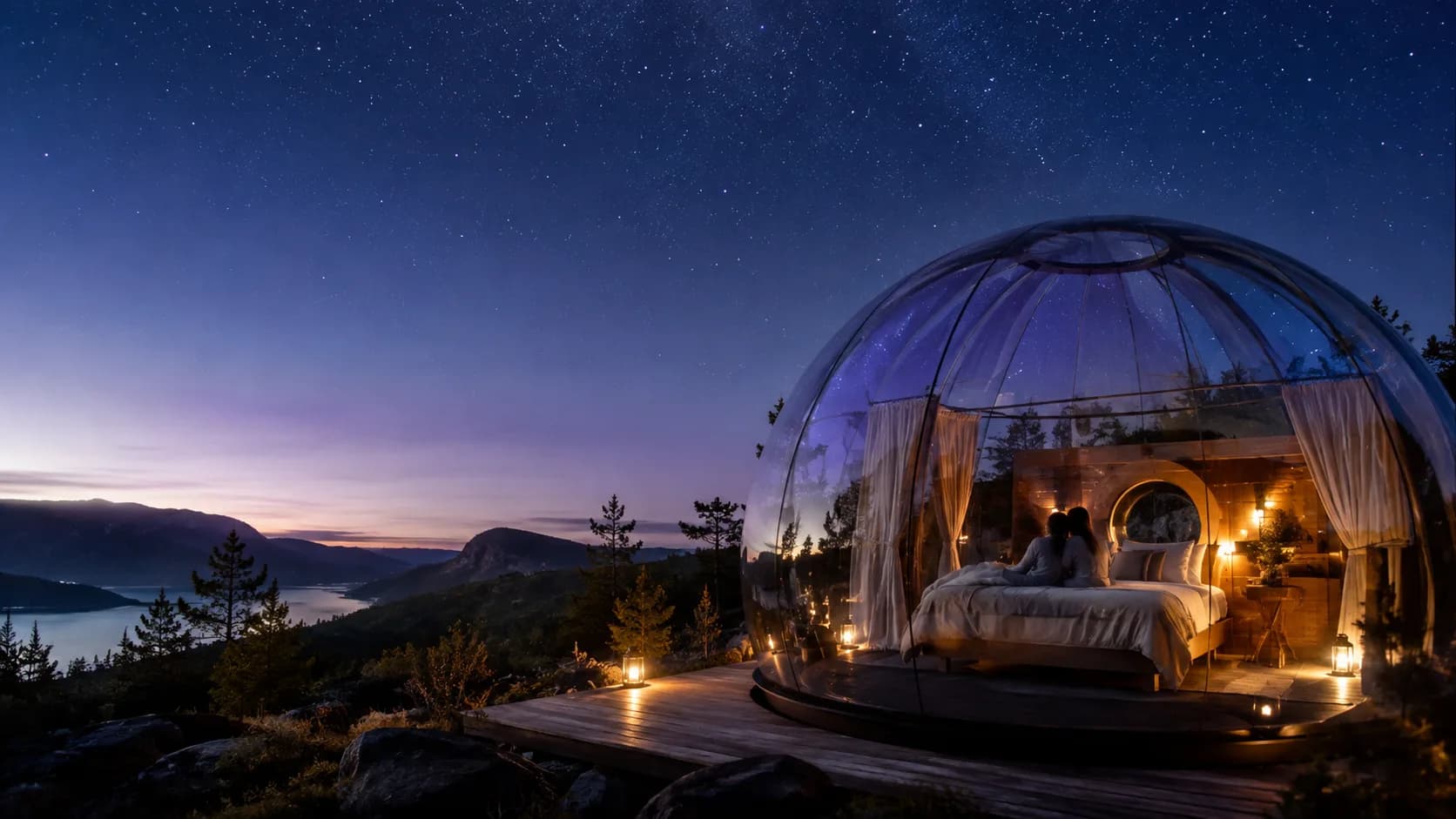
Sleeping in a Transparent Bubble: A Warm Night Under the Stars
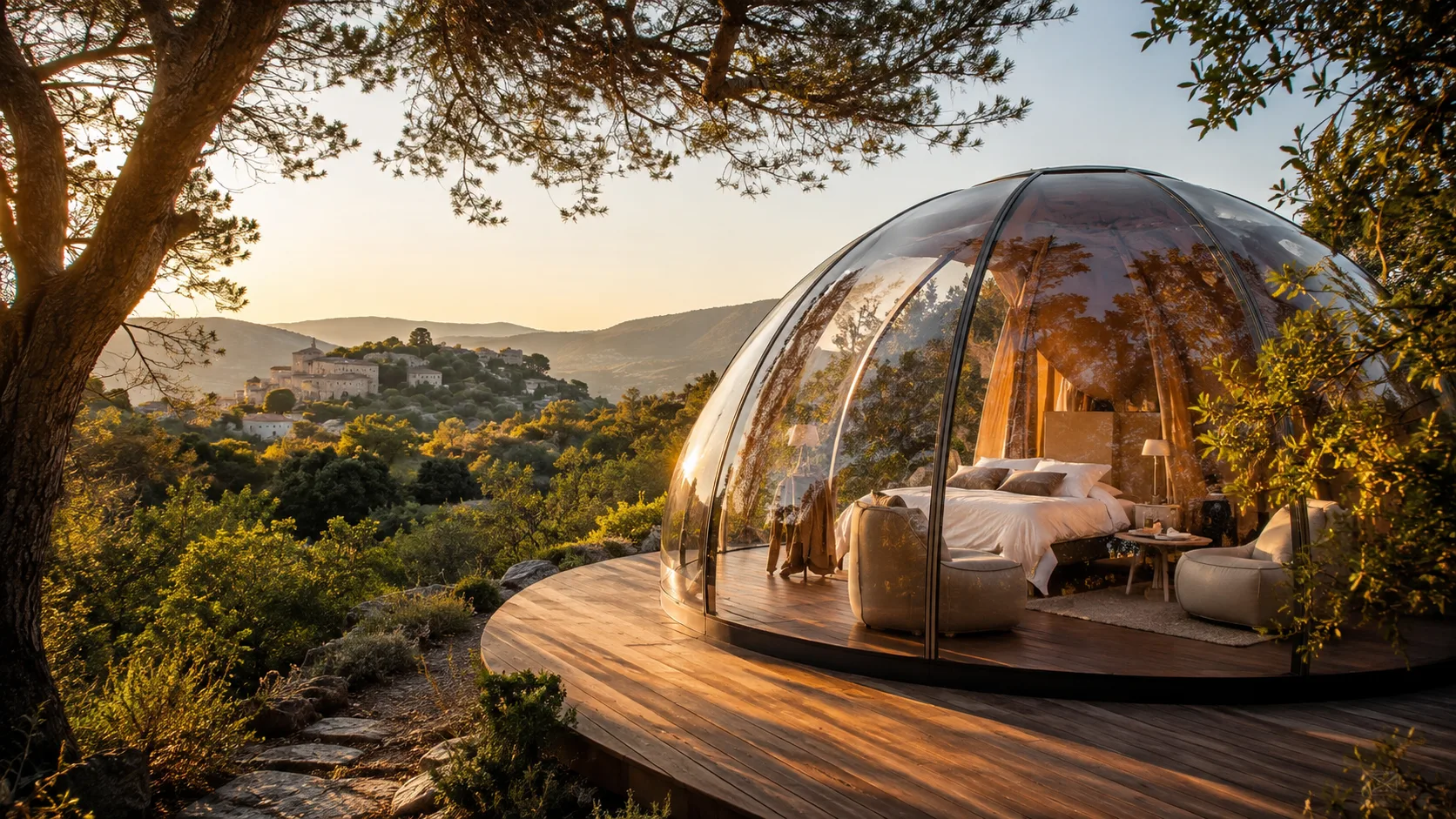
Sleeping beneath a large transparent wall offers something a conventional hotel room struggles to recreate: lying in a proper bed while keeping the sky and surrounding landscape within view.
That is where the real appeal lies. Not necessarily in the shape of the room or the technology used to build it, but in this unusual connection with the outdoors.
From bed, the trees remain visible. Clouds drift overhead. Once night falls and the lights are switched off, the sky still feels like part of the room.
It also explains why the word “bubble” now covers several different types of accommodation. Some are genuine inflatable bubbles. Others are geodesic domes or rigid structures with large transparent sections.
For guests, that distinction only really matters when it changes the experience itself: noise, temperature, ventilation or the way the room is laid out.
Before getting into those details, the first questions are much simpler: where can you sleep in a transparent bubble in France, how much does it cost, what do you actually get for the price, and how do you choose one for a night away as a couple?
Where can you sleep in a transparent bubble in France?

The transparent accommodation currently listed on Love in Room is spread across several parts of France.
Two properties are located in Allauch, near Marseille. The others are in Aude, Tarn-et-Garonne, Ardèche, Haute-Savoie, Haute-Loire, Dordogne, Charente and Hautes-Alpes.
This distribution reflects the properties listed in the Love in Room catalogue at the time of our review. It is not intended as a complete census of every bubble stay available in France.
For the two properties in Allauch, you can also browse the Love Rooms near Marseille, where they appear alongside other places to stay in the area.
Destination obviously matters, but this particular type of accommodation depends heavily on its immediate surroundings.
A transparent room tucked into a wooded plot does not offer the same experience as a dome facing the mountains, or a bubble located within a larger estate containing several other units.
The landscape visible from the bed effectively becomes part of the accommodation.
The direction of the transparent section, the surrounding vegetation and the distance from neighbouring rooms are therefore just as important as the interior design.
How much does a night in a transparent bubble cost?
Prices vary considerably, and Love in Room’s own catalogue gives us something more useful than a rough estimate.
Among the ten transparent accommodation listings currently referenced on Love in Room, the median price is €197 per night for two people, with prices ranging from €119 to €365. Three of the ten cost more than €250.
These figures describe the Love in Room catalogue at the time of the review. They should not be taken as representative of the entire French market.
Two things stand out.
First, nine out of ten have a private hot tub. In this particular segment, a spa is therefore less of an optional extra and more a regular part of the overall product.
Second, the difference between €119 and €365 is not simply explained by the size of the room. The setting, level of seclusion, bathroom facilities, services and season all play an important role.
Two structures that look almost identical in photographs can therefore offer very different stays.
The question is not simply: how much does a night in a bubble cost?
It is also worth looking at what is actually included.
A transparent dome on its own private plot, with no overlooking neighbours, a hot tub, private bathroom and services available on site does not offer the same experience as a similar-looking structure on a more densely developed estate with shared facilities.
A photograph of the room alone rarely tells the whole story.
A bubble with a private hot tub: what does it add to the experience?
The combination of a panoramic room and a private hot tub is particularly common.
In the Love in Room catalogue, nine of the ten transparent stays currently listed include a private hot tub.
It is easy to see why the two work so well together.
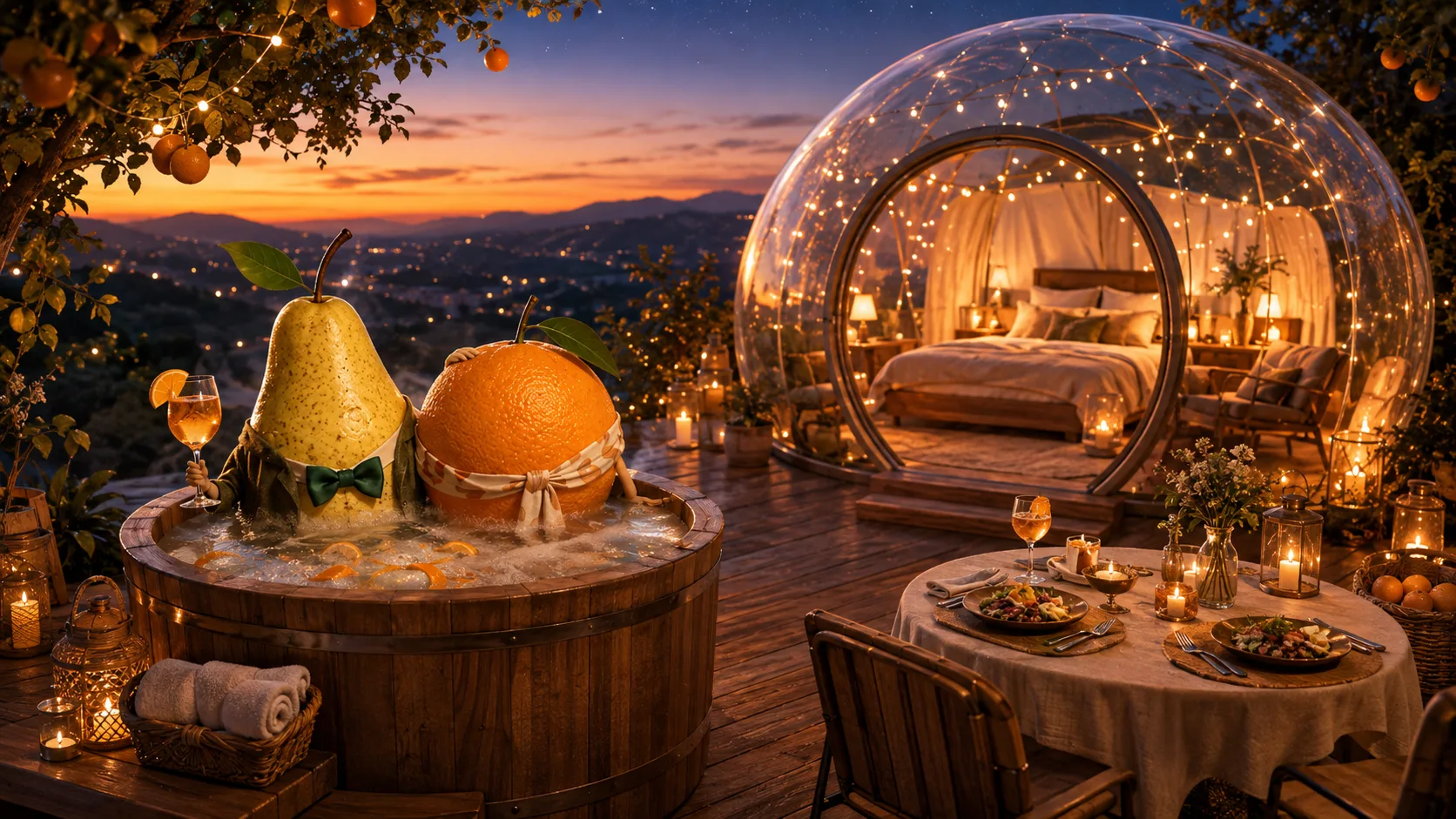
You arrive in the late afternoon, settle in and get into the hot tub as the sun begins to drop. Dinner is served on site or just a few metres from the room. Later, you switch off the lights, get into bed and the sky is still there above you.
That continuity is arguably what the hot tub adds most to the stay: it allows the entire evening to take place within the same setting.
Its exact location, however, varies considerably.
The spa might sit directly outside the room, on a terrace, beneath a shelter, behind a privacy screen or in the middle of an entirely secluded plot.
The word private tells you that the hot tub is reserved for the occupants of the accommodation. It does not necessarily tell you how hidden it is from view.
For a couple’s stay, exterior photographs are therefore just as useful as close-ups of the hot tub itself. They show how the spa fits into the site and how far it actually sits from the room.
That distance becomes more noticeable in winter.
Walking a few metres across a terrace in July is insignificant. Doing the same when temperatures are close to freezing and you have just climbed out of hot water is a very different sensation.
Opening hours and whether the hot tub is covered can also vary from one property to another.
A hot tub also has its own filtration system and technical equipment. When installed directly beside the sleeping area, its position can have some effect on the overall sound environment.
A spa therefore works particularly well with a bubble or panoramic dome when the entire place — setting, view, privacy and room — has been designed as a coherent whole.
How do you choose a bubble for a night away as a couple?
Once you have chosen the destination and budget, several practical details help distinguish between properties that may look remarkably similar online.
Transparency and privacy
The defining feature of these rooms is that part of the usual boundary between indoors and outdoors disappears.
From bed, you can look at the trees, watch the clouds or keep the sky within view without stepping outside.
Naturally, transparency works both ways.
When the interior is illuminated and the surroundings are dark, the room becomes easier to see from outside. That is precisely why the position of the accommodation matters so much.
A panoramic wall facing woodland or an isolated plot offers a very different setup from the same opening facing a path used by other guests.
Look at photographs taken from outside the accommodation as carefully as those showing the view from the bed.
Vegetation, fencing, privacy screens, curtains and, above all, the distance from neighbouring accommodation quickly reveal how privacy has been handled.
A partly opaque structure is not necessarily less appealing.
A sheltered sleeping area combined with a large panoramic opening facing the sky can offer an excellent balance between the view and privacy.
Summer, winter and condensation
Sleeping beneath a large transparent surface is not quite the same as staying in a conventional room.
In summer, a surface exposed directly to the sun can build up heat more easily. Ventilation, shade, orientation and air conditioning therefore become particularly important.
For a stay in July or August, air conditioning is useful information. So is the setting itself: a structure beneath trees will behave differently from one exposed to direct sunlight for most of the day.
In winter, heating becomes the more important question.
A night beneath the stars can work perfectly well in December when the accommodation has been designed for year-round use and fitted with appropriate heating.
Not every transparent structure provides the same level of insulation, however. The equipment specified by the host is therefore a better guide than the type of accommodation alone.
Condensation also depends on several factors: the temperature of the surfaces, humidity in the air and ventilation.
It is neither unavoidable nor unique to transparent accommodation.
In some inflatable bubbles, the continuous renewal of air actually helps reduce the problem. In other structures, the result depends more heavily on the ventilation system and weather conditions.
There is also one obvious factor no accommodation can control: the weather.
A transparent room gives you a view of the sky. It cannot guarantee stars.
Some nights will be spent looking at constellations. Others may involve watching rain or clouds move above the bed. The view remains part of the experience; only the scenery changes.
Bathroom facilities
Bathroom arrangements vary considerably between properties.
Some rooms have a fully integrated bathroom. Others use an adjoining extension, while a few have bathroom facilities in a separate building nearby.
None of these arrangements automatically makes for a poor stay.
They simply offer different levels of convenience.
Knowing the actual distance between the bed and the bathroom is therefore useful, particularly in winter or during bad weather.
Access and parking
Seclusion is often one of the strongest features of this type of accommodation.
A bubble positioned away from the main buildings can provide a greater sense of privacy and a better view. It may also mean that the car park is a short walk away.
With a small overnight bag, that makes little difference. With several suitcases, a late arrival or wet ground, it becomes more noticeable.
Access information simply allows you to know what to expect before you arrive.
Dinner
Dinner can also shape the rhythm of the stay.
Some properties offer meal baskets, a small kitchen or an on-site restaurant. Others require guests to get back into the car if they want to eat out.
When the point of the evening is to enjoy the accommodation itself, being able to stay on site can matter as much as some of the room’s more obvious amenities.
Once you have chosen the view and the setting, these details — bathroom facilities, temperature, access and food — determine much of the actual comfort of the stay.
What is the most unusual place to spend the night in France?
There is no single form of unusual accommodation, because each type offers something different.
A treehouse is largely about height and immersion among the trees. You leave the ground behind and, in some cases, the surrounding buildings too.
A gypsy caravan is more about its own self-contained world. The compact space, woodwork and interior design create an atmosphere unlike a standard room.
A troglodyte room makes the architecture itself the experience: you are sleeping inside the rock.
A floating cabin changes your relationship with the water. The view, movement and sometimes the sounds around you become part of the stay.
A bubble or panoramic dome works differently.
In many unusual places to stay, the novelty comes primarily from the building itself. Here, it comes largely from the view.
The room may actually be quite simple: a bed, a few pieces of furniture and relatively understated decoration.
What changes is that the outside world is still there once you lie down.
Trees, mountains and sky remain visible after the rest of the evening has ended.
That is what a bubble does particularly well: it turns the surrounding landscape into part of the room itself.
There is therefore no objective answer to the question of the most unusual night in France.
The best choice depends on what appeals to you: sleeping above the ground, spending the night inside an extraordinary building, being surrounded by water, or keeping the open sky above your bed.
Transparent bubble or geodesic dome: what is the difference?
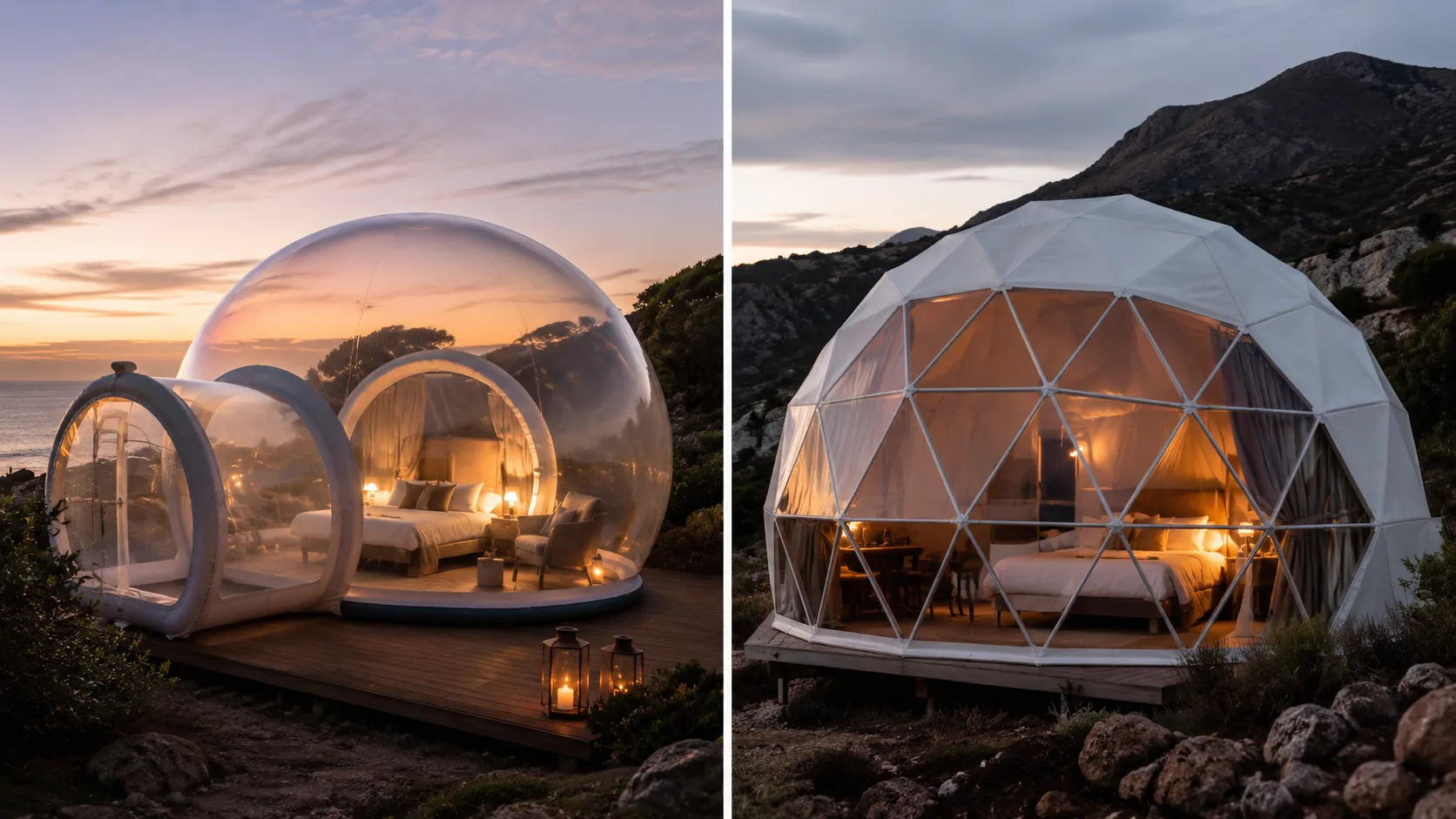
The word “bubble” is used quite loosely in the unusual accommodation market.
It can describe a genuine inflatable structure as well as a rigid dome with a large panoramic opening.
A geodesic dome has a structural frame. Its rounded shape is created from a network of sections, usually triangular.
That is normally the easiest clue to spot in photographs: rather than one completely smooth surface, you can see the different facets of the structure.
Some geodesic domes are almost entirely transparent.
Others combine an opaque shell with a large panoramic section facing the sky, mountains, woodland or countryside.
Their frame supports the structure mechanically, so they do not need a blower to keep them upright.
An inflatable bubble works differently.
On some models, a flexible membrane is held under slight positive pressure by a continuously operating blower. An airlock then allows guests to enter and leave without causing a sudden drop in pressure inside the structure.
A few details in a listing often help identify what you are looking at.
Visible triangular facets are a strong indication of a geodesic dome. A smooth, almost spherical surface combined with a tunnel or airlock entrance is more typical of an inflatable bubble.
References to an “airlock”, “blower”, “fan” or “positive pressure” usually make the distinction clearer.
The difference becomes genuinely useful when it affects the stay itself: noise, ventilation or the layout of the room.
A blower? Only in some inflatable bubbles
Sleeping beneath a transparent surface does not automatically mean having a fan running somewhere nearby throughout the night.
A geodesic dome or another rigid structure does not need one to maintain its shape.
Some genuine inflatable bubbles, however, rely on a blower running continuously to keep the structure pressurised. The same system also helps renew the air inside.
Accommodation systems are designed to minimise disturbance. How noticeable the sound is will then depend on the distance between the blower and the bed, the quality of the installation and individual sensitivity to background noise.
If you are a light sleeper and the listing clearly shows an inflatable bubble, one simple question is usually enough: does the blower run throughout the night, and where is it positioned in relation to the bed?
With a rigid dome, that particular question does not apply.
The room may still contain other audible equipment, including air conditioning, ventilation, heating or the technical system used by the hot tub.
The word “bubble” in the title of a listing therefore tells you very little, by itself, about how quiet the accommodation will be.
So, who is a night in a bubble really for?
Bubbles and panoramic domes are particularly suited to travellers for whom the accommodation itself is part of the evening, rather than simply somewhere to sleep.
You do not choose one simply because the bed happens to be inside an unusual structure.
You choose it because the land, sky, trees or wider landscape remain present right up until you fall asleep.
The best option is therefore not necessarily the most transparent structure or the one with the longest list of amenities.
It is the one where the view, privacy, comfort, hot tub if there is one, and overall layout work together.
When those elements are right, the precise type of structure almost becomes secondary.
Read also
Continue your editorial journey
Romantic Getaways: Why Unusual Stays Can Bring You Closer
Sleeping in a treehouse, under a transparent dome or on the water changes your habits, your pace and the attention you give each other. Here is why unusual places can create more room for connection — and how to choose the kind of stay that suits you both.
Hammam or sauna: which to choose as a couple, and in what order with the jacuzzi
Dry or humid heat, how long to stay in, the order with the jacuzzi, and champagne: what is established, what is only a convention, and a timed plan for a private spa evening for two.
Wedding Anniversary: Gifts, Messages & Celebration Ideas
Find the right gift, write something personal and decide how to celebrate your wedding anniversary. Includes the French anniversary chart and real prices from 1,161 Love in Room stays.