
Moon Sign: Emotions, Love and Rising Sign
The Moon sign is associated with emotions and emotional needs in astrology. But it becomes more interesting when compared with your Sun and rising sign: what you show on a first date may not be what you need once the door is closed.
Moon Sign: The Sign That Governs Your Emotions (and How You Love)
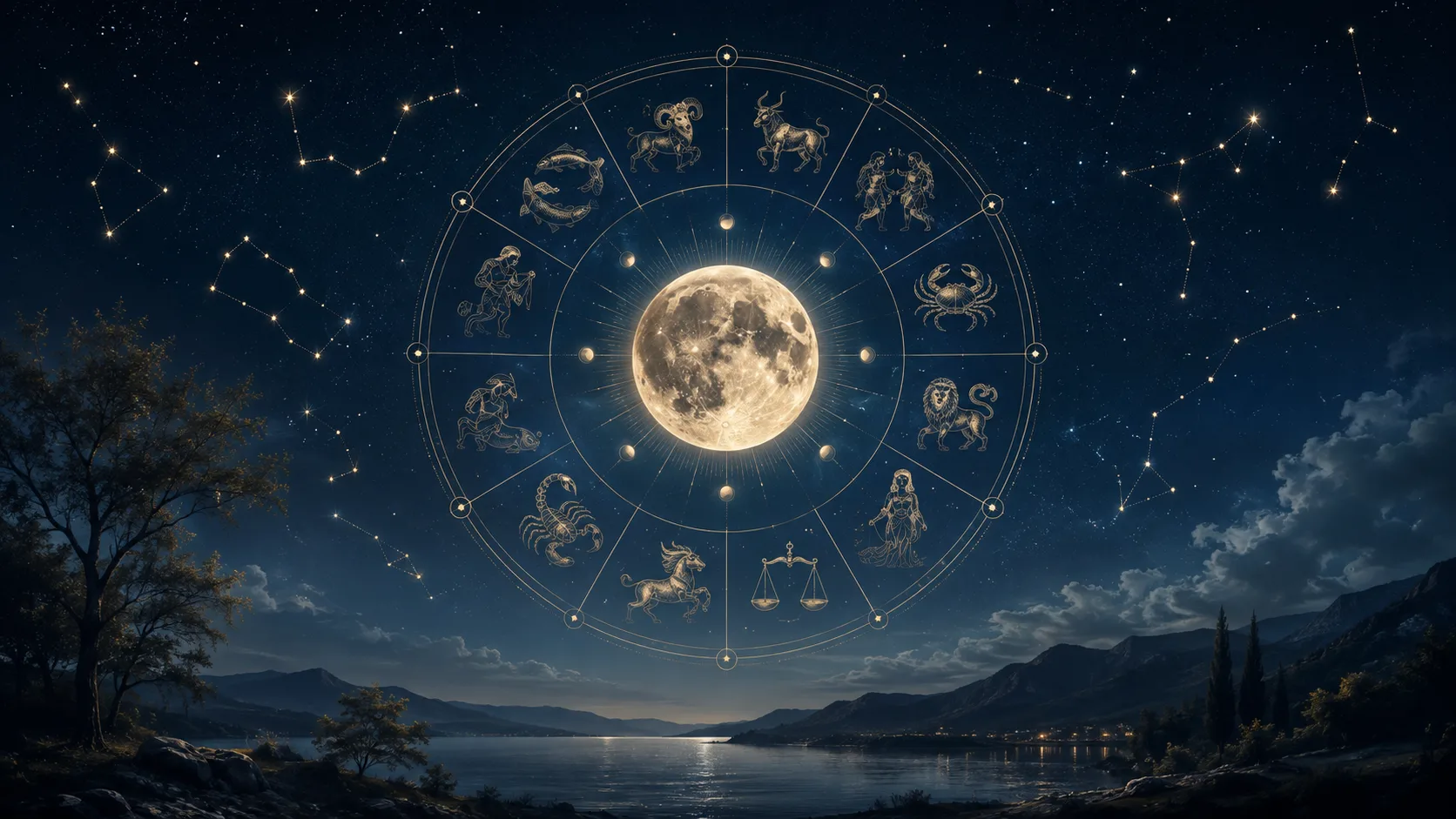
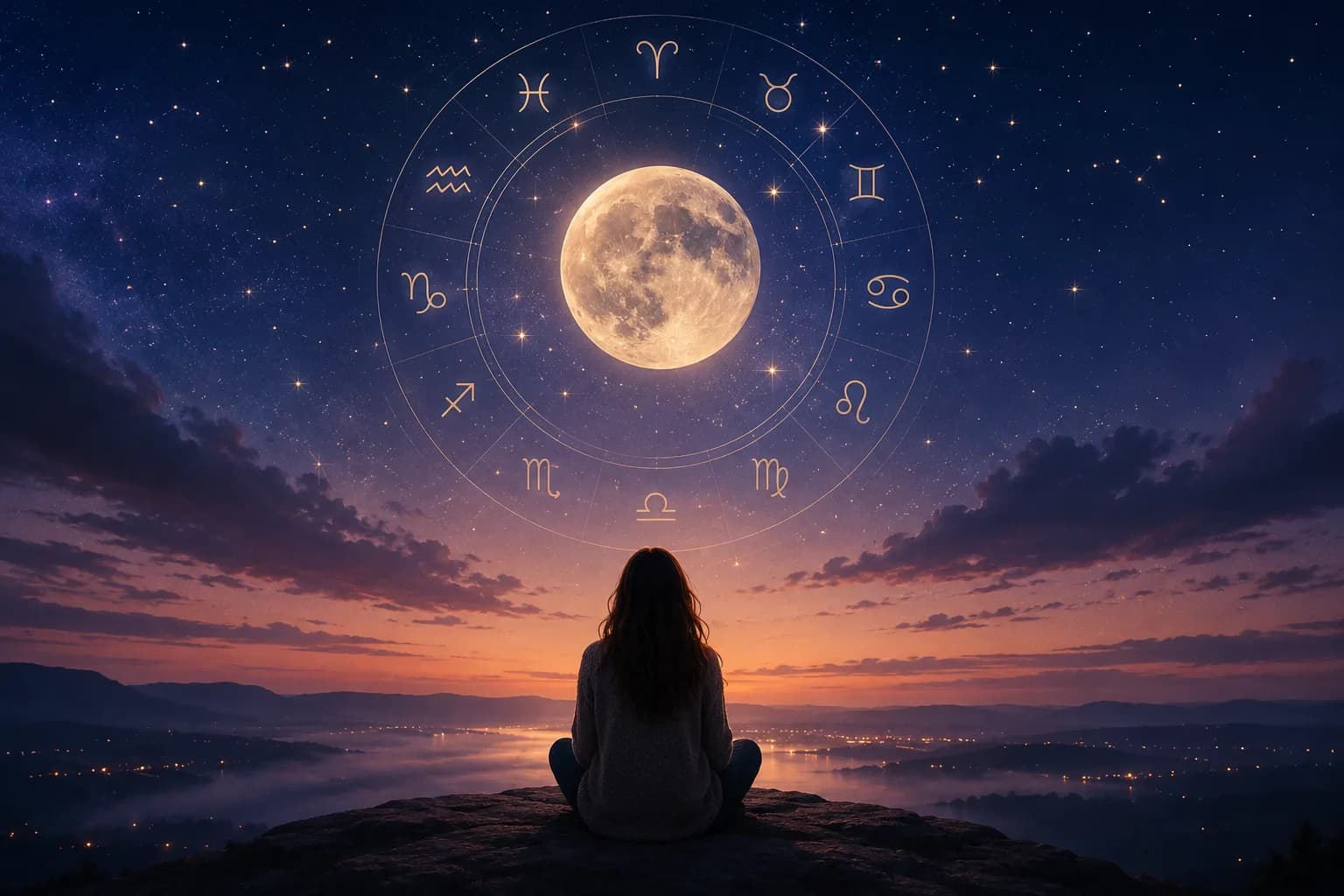
The Moon sign is often described in astrology as the sign that “governs” emotions, emotional needs and part of our private life. That wording should be understood as an astrological convention, not a physical mechanism: there is no scientific evidence showing that the position of the Moon at birth determines how you love.
The more interesting use is different. This framework can give you vocabulary for talking about what you need from another person once a relationship becomes close: reassurance, space, conversation, calm, stability, or simply the freedom to be vulnerable without feeling judged.
And the Moon sign becomes much more interesting when you stop reading it in isolation. Your Sun sign, Moon sign and rising sign can point in quite different directions. In a relationship, those differences may be more useful to explore than any individual sign on its own.
Sun, Moon and Rising Sign: Three Different Things We Often Confuse
When someone asks for your zodiac sign, they usually mean your Sun sign. In astrology, it corresponds to the Sun’s position in the zodiac when you were born and can almost always be determined from your date of birth alone.
In modern astrological interpretations, the Sun is commonly associated with conscious identity, aspirations and the way you define yourself. The Moon is more closely associated with emotional reactions, your inner life and your need for security.
The Ascendant, or rising sign, is calculated differently. It is the zodiac sign that was rising on the eastern horizon at the exact time and place of your birth. Astrology commonly interprets it as the way you enter situations, your instinctive social manner or the impression other people initially receive.
Different schools of astrology do not assign exactly the same meaning to all three. But for the purposes of looking at relationships, a useful shorthand is:
Sun: what I recognise as myself.
Moon: what I need when I let my guard down.
Rising sign: what the other person encounters first.
It is a simplification, but it explains why the three placements can sometimes seem to tell rather different stories.
What Is a Moon Sign?
Your Moon sign is simply the zodiac sign in which the Moon was located when you were born.
In modern Western astrology, it is commonly used to discuss emotional life, instinctive reactions and the need for security. The Moon’s astronomical position can be calculated accurately; the meaning attributed to that position belongs to astrological interpretation.
What Is the Difference Between Your Moon Sign and Rising Sign?
Your Moon sign corresponds to the Moon’s position within the zodiac. Your rising sign, or Ascendant, is the sign that was rising in the east from your birthplace at that particular moment.
For relationship purposes, the distinction can be useful. The rising sign can be used to think about how you enter a situation or the first impression you give, while the Moon can be used to explore what you seek once you feel safe enough to relax that initial posture.
Someone might therefore seem highly outgoing on a first date and later need a great deal of quiet and stability in private. Those two things do not necessarily contradict one another: the astrological framework is simply looking at two different layers.
Finding Your Moon Sign: What You Need to Know and Why Birth Time Matters
To calculate your Moon sign, astrology tools generally ask for your date, time and place of birth. Technically, for the Moon’s geocentric zodiac position, the most important information is the actual moment of birth; your birthplace also allows the calculator to convert your local birth time correctly.
The Moon completes an orbit relative to the stars in about 27.3 days. Within an astrological zodiac divided into twelve signs, it therefore changes signs roughly every two to three days.
That is why birth time can matter, although it does not matter equally for everyone. If the Moon remained in the same zodiac sign throughout the day you were born, an approximate birth time will not normally change your Moon sign.
If the Moon moved from one sign into another that day, however, a difference of several hours can change the result.
Birth time and location are much more important when calculating your rising sign because the Ascendant depends directly on the local horizon. Saying that the rising sign changes approximately every two hours is only a rough average: the actual rate varies with latitude and with the sign concerned.
This article uses the tropical zodiac, which is standard in much of Western astrology. A calculator using the sidereal zodiac may give you a different sign.
How Do I Find My Moon Sign?
Take your date of birth, your birth time if you know it, and your birthplace, then enter them into an ephemeris or a free natal-chart calculator.
If you do not know your birth time, check whether the Moon changed signs on your date of birth. If it stayed in the same sign all day, you can usually identify your Moon sign despite the missing time.
What the Moon Sign Really Describes: Need, Not Personality
Saying “Cancer Moons are sensitive” or “Aries Moons are impulsive” quickly turns a symbolic framework into a fixed personality portrait.
For relationships, another question is more useful:
What does this Moon need in order to feel comfortable in a relationship?
Instead of deciding what kind of person you are, you use the description to test a hypothesis. Does stability reassure me? Do I need to talk immediately after an argument? Do I need time alone before I can reconnect?
Take someone who relates to the description of a Taurus Moon. The point is not to conclude that they are “calm” or “materialistic”. A better question is whether routines, continuity and predictable gestures play an unusually important role in making them feel secure.
That leads to much more practical questions:
When I am struggling, do I need you to talk to me, or simply to stay beside me?
Does spontaneity relax me, or put me on edge?
After an argument, do I need to resolve things immediately, or calm down before we talk?
Even within relationship astrology, the Moon is only one part of the picture. Venus, Mars, the Ascendant, houses and aspects between two birth charts are also used in synastry.
Here, we are deliberately using the Moon for just one purpose: to talk about emotional needs, not to summarise your entire way of loving.
Am I More Lunar or Solar?
For the approach used here, you do not have to choose between being “lunar” and “solar”. Your birth chart contains both a Sun and a Moon, and astrology assigns different symbolic functions to each.
Some astrological traditions do describe people as more “solar” or “lunar” when looking for dominant themes in a birth chart. That is not the distinction we are using here.
You may simply recognise yourself more strongly in some descriptions of your Moon than in descriptions of your Sun sign.
And that difference can be more interesting than deciding which one “sounds more like you”.
The Twelve Moon Signs, Seen Through Emotional Needs
The following is a summary of what Western astrology commonly associates with each Moon sign. Read it as a hypothesis to test, not as a portrait of who you are.
Aries Moon
A need for honesty, autonomy and the ability to act. After a problem, there may be a strong desire for things to move forward rather than remain trapped in unspoken tension. What weighs heavily: situations that feel stuck, endless hints and the sense that nothing can be done.
Taurus Moon
A need for stability, continuity and tangible comfort. Consistent gestures — being there, keeping your word, returning to shared rituals — carry particular weight in this reading. What weighs heavily: permanent unpredictability and changes imposed without warning.
Gemini Moon
A need to understand through conversation. Putting things into words can help untangle what is happening and allow emotions to move. What weighs heavily: subjects that cannot be discussed, silence used to shut down a conversation, or feeling unable to ask why.
Cancer Moon
A need for emotional security, familiarity and somewhere you can lower your guard. Feeling “at home” with another person is especially important in this interpretation. What weighs heavily: emotional coldness and the sense that vulnerability is not welcome.
Leo Moon
A need for warmth, recognition and affection that can actually be perceived. Being loved matters, but seeing or hearing evidence of that love matters too. What weighs heavily: indifference, feeling overlooked or repeatedly devalued.
Virgo Moon
A need for a manageable daily life and useful gestures. Helping, anticipating, easing a difficulty or noticing small details can carry a great deal of relational meaning. What weighs heavily: long-term chaos and feeling that everything continually falls on your shoulders.
Libra Moon
A need for balance, cooperation and an exchange in which both people can be heard. Disagreement itself is not necessarily the problem if dialogue remains possible. What weighs heavily: aggressively confrontational dynamics and an inability to find common ground again.
Scorpio Moon
A need for depth, trust and loyalty. In this reading, a difficult but honest conversation may feel safer than superficial harmony. What weighs heavily: betrayal, half-truths and the sense that important subjects are deliberately being avoided.
Sagittarius Moon
A need for space, movement and openness. Being close does not necessarily mean doing everything together or giving up individual freedom. What weighs heavily: control, confinement and the feeling that the relationship is gradually making your world smaller.
Capricorn Moon
A need for reliability, clear boundaries and evidence that lasts over time. Actions may carry more meaning than the expectation to discuss every emotion the moment it appears. What weighs heavily: inconsistency and being pushed to open up before you are ready.
Aquarius Moon
A need for autonomy, perspective and the ability to remain yourself inside the relationship. Taking some distance can sometimes help clarify what you are feeling. What weighs heavily: possessiveness and pressure to react emotionally in exactly the expected way.
Pisces Moon
A need for gentleness, compassion and somewhere emotions can exist before being analysed. Not everything painful needs to be solved immediately. What weighs heavily: harshness and the feeling that every emotional reaction must be justified.
When Your Moon and Rising Sign Tell Different Stories
This is probably where the trio becomes most interesting for relationships.
Take a Leo rising with a Cancer Moon. Within this framework, the first impression may be warm, expressive or confident, while intimacy reveals a much stronger need for security and familiarity.
The useful question is not whether everyone with this combination behaves in exactly the same way. It is:
Does what I show easily really resemble what I need in private?
A Gemini rising paired with a Scorpio Moon creates another possible contrast. The first interaction may appear light, talkative and adaptable, while close relationships may require much more depth and trust.
That can surprise the other person: someone who talks easily about many things is not necessarily someone who finds it easy to reveal what matters most.
With a Capricorn rising and an Aries Moon, the contrast may look different. A fairly restrained or controlled first impression can coexist with a strong need for quick action when something goes wrong.
These combinations are not diagnoses.
They are useful because they highlight a question that is often missed early in a relationship: does the way I come across actually give the other person accurate information about what I need?
Two Moon Signs in a Relationship: Where Needs Can Rub Against Each Other

Comparing two Moon signs cannot tell you whether a couple is compatible. Even within relationship astrology, synastry cannot be reduced to two Moon placements, and no combination can scientifically predict whether a relationship will succeed or fail.
The examples below are simply scenarios built from the symbolic needs associated with each Moon.
Aries and Taurus offer a straightforward example. If one person needs an immediate response while the other needs to regain a sense of stability first, conflict can create a difference in timing: “let's talk about it now” meets “give me a few hours.”
The danger is not necessarily the difference itself. It is the interpretation: one person thinks they are being ignored, while the other feels pressured.
Gemini and Scorpio can miss each other in a different way. One person may work out what they feel by talking, revisiting events and exploring several angles; the other may want to go straight to the issue they consider essential.
Lots of words can seem superficial to one. Lots of intensity can feel disproportionate to the other.
Cancer and Aquarius illustrate another contrast: closeness versus space. Trouble starts when “I need you near me” becomes “you are trying to control me”, or “I need some time alone” is heard as “I don't care about you anymore.”
A Virgo Moon and a Sagittarius Moon may also respond differently to a difficulty. One starts organising, checking details or looking for a practical solution; the other may prefer to step back, go outside or change perspective before returning to the issue.
Finally, Leo and Capricorn may simply fail to recognise each other's signs of affection. One wants more visible recognition; the other may believe that consistency and simply being present already communicate everything clearly.
None of these examples says that a pairing works or does not work.
They simply show how two people can both think “I'm doing exactly what is needed” while responding to entirely different needs.
You do not have to wait for a conflict before comparing your answers. A quiet dinner, an evening at home or somewhere peaceful where nobody is waiting for you may be a better setting for talking about what actually makes each of you feel secure.
The Moon sign then becomes less of a portrait and more of a question:
When you're not okay, what do you actually need from me?
What This Framework Cannot Do
The astronomical position of the Moon at the moment of your birth can be calculated accurately. The idea that this position corresponds to emotional needs or can help predict a relationship belongs to astrological interpretation.
Controlled research has not established that natal charts can reliably describe or predict an individual's personality.
This framework therefore cannot decide whether someone is right for you. It cannot diagnose a relationship problem, explain another person's behaviour on its own or turn a genuine incompatibility into a simple “Moon-sign clash”.
It becomes more useful when you ask much less of it.
Read the description of your Moon sign and ask yourself: does this need sound like me? Then ask your partner the same question.
If the answer is no, there is nothing wrong with your chart.
If the answer is yes, you may simply have found a more precise way to describe something you already knew but had never quite put into words.
That may be the most useful way to bring this framework into a relationship.
Not to predict.
Not to explain the other person for them.
To give you a reason to ask a better question.
Read also
Continue your editorial journey

Truth or Dare for Couples: 100 Questions and Dares, from Sweet to Spicy
Start with the sweet questions and decide together how far you want to go. These 100 truth or dare cards move from funny memories and unexpected confessions to flirty challenges designed for two.
36 Questions to Fall in Love
The famous 36 questions to fall in love came from a real psychology study, but the research never claimed to manufacture love. Here are all 36 questions, how the 45-minute protocol actually worked, what it measured, and why the famous four minutes of eye contact are usually attributed to the wrong experiment.

How to Write a Love Poem When You're Not a Poet: 5 Steps
Writing a love poem gets harder the moment you start trying to sound poetic. A simpler method is to begin with one real detail, forget forced rhymes, write in prose first and shape it afterwards. Plus 12 original love poems you can use or personalise.